


Agriculture
A divided Farm Bill, an expired extension, and farm groups that agree on less than it looks.
Pre-election edition | October 26, 2026
Before you read on
Most pre-election analysis asks who gains power and what the new priorities will be. That matters, and you will read plenty of it. This brief starts somewhere else. It is a framework to think with, not a forecast. It asks how what happens on the Hill will change the position of the other groups on your issues, farm and commodity groups, state governments, lenders and equipment makers, and food and consumer interests, and what that means for the strategic and tactical options open to you in 2027.
A change in priorities can hurt one group and hand another an opening. It can also give organizations reasons to work together that did not exist before. Those who see it first can use it to advance their own plans.
The sector question
Which decisions on the Farm Bill, USDA programs, and farm-adjacent policy will shape agricultural organizations’ goals in 2027, who else is working on them, and where is government-affairs effort worth spending?
The next Farm Bill is the clearest congressional decision point for agriculture, but it is not a single farm-sector vote. The House passed H.R. 7567 in April; the Senate Agriculture Committee reported its own Agricultural Act of 2026 in September. The bills leave material questions to resolve around nutrition, conservation, commodity support, livestock standards, and biofuels. A new majority could change negotiating priorities and oversight of USDA, but party control alone will not reconcile the bills or establish the next committee chair. The 2018 Farm Bill extension reached its statutory end date on September 30, 2026.
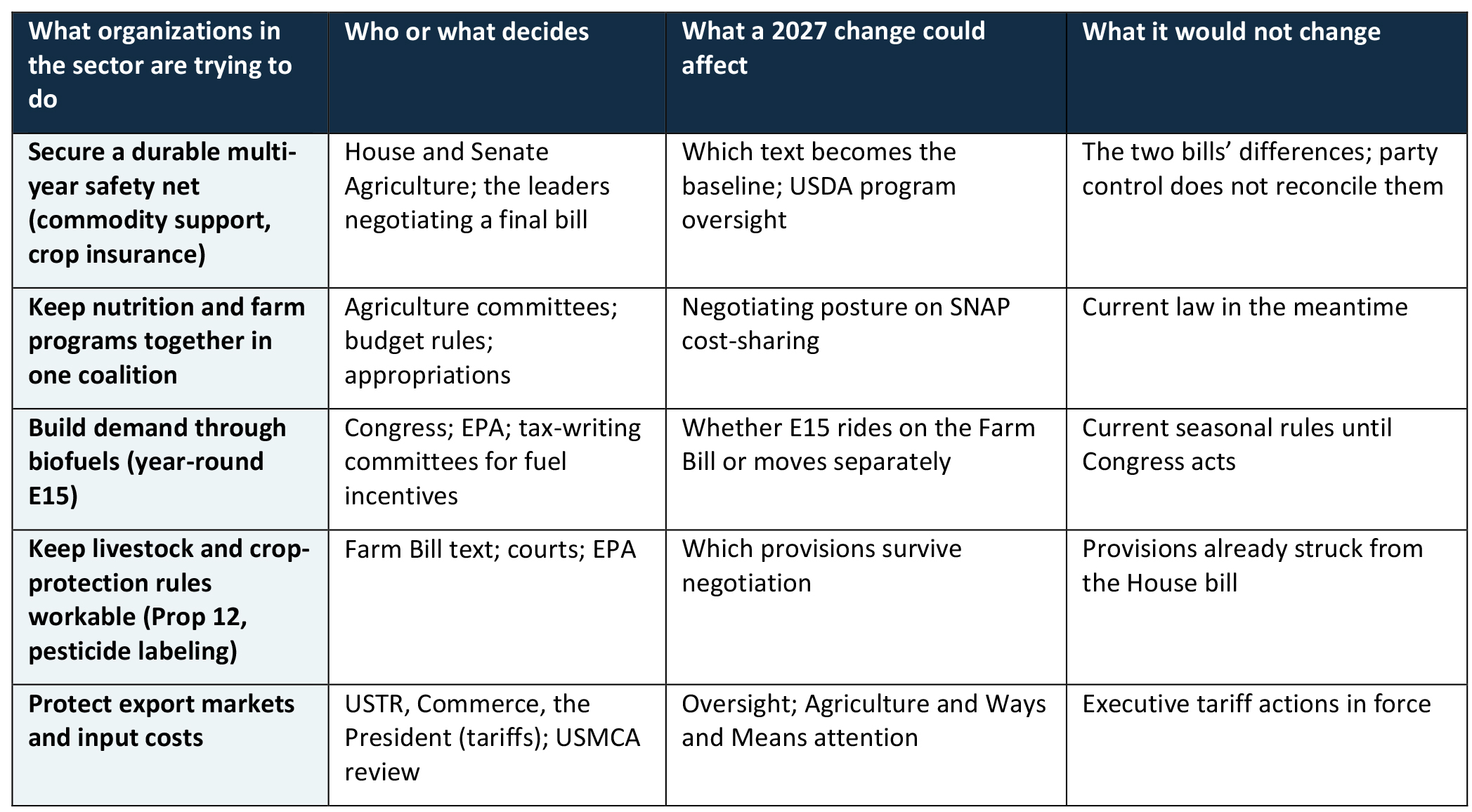
From organizational objective to Washington lever
What the record shows
- Two texts, no deal. The House passed H.R. 7567 224–200 on April 30. The Senate Agriculture Committee advanced its Agricultural Act of 2026 12–11 on a party-line vote on September 16, after a first markup in August failed to move it. A Senate office describes the “Four Corners” leaders still negotiating a final bill as of October 22.
- SNAP is the gate. The Senate bill delays states’ cost share of SNAP benefits one year; Democrats want two years for all states. Sen. Klobuchar tied the dispute to tariff-related grocery prices and said states that cut their error rates should not be disadvantaged. Chairman Boozman called his August offer “the final offer.”
- Other open questions. The Senate bill authorizes year-round E15. The House bill carries a Proposition 12 provision that dominated floor debate; the Senate bill does not. Mandatory country-of-origin labeling for beef is a point in the negotiation. The House struck three pesticide sections (10205–10207) 280–142 before passage.
- The farm economy is pressing. The National Corn Growers Association and the American Farm Bureau are urging Congress to finish the farm bill and year-round E15 when members return in November.
Beyond the Hill: who else has a stake
Hill work is one lever. The positions of trade groups, customers, competitors, advocates, state governments, and others often decide what is achievable and where. The groups below are already acting on the same issues.
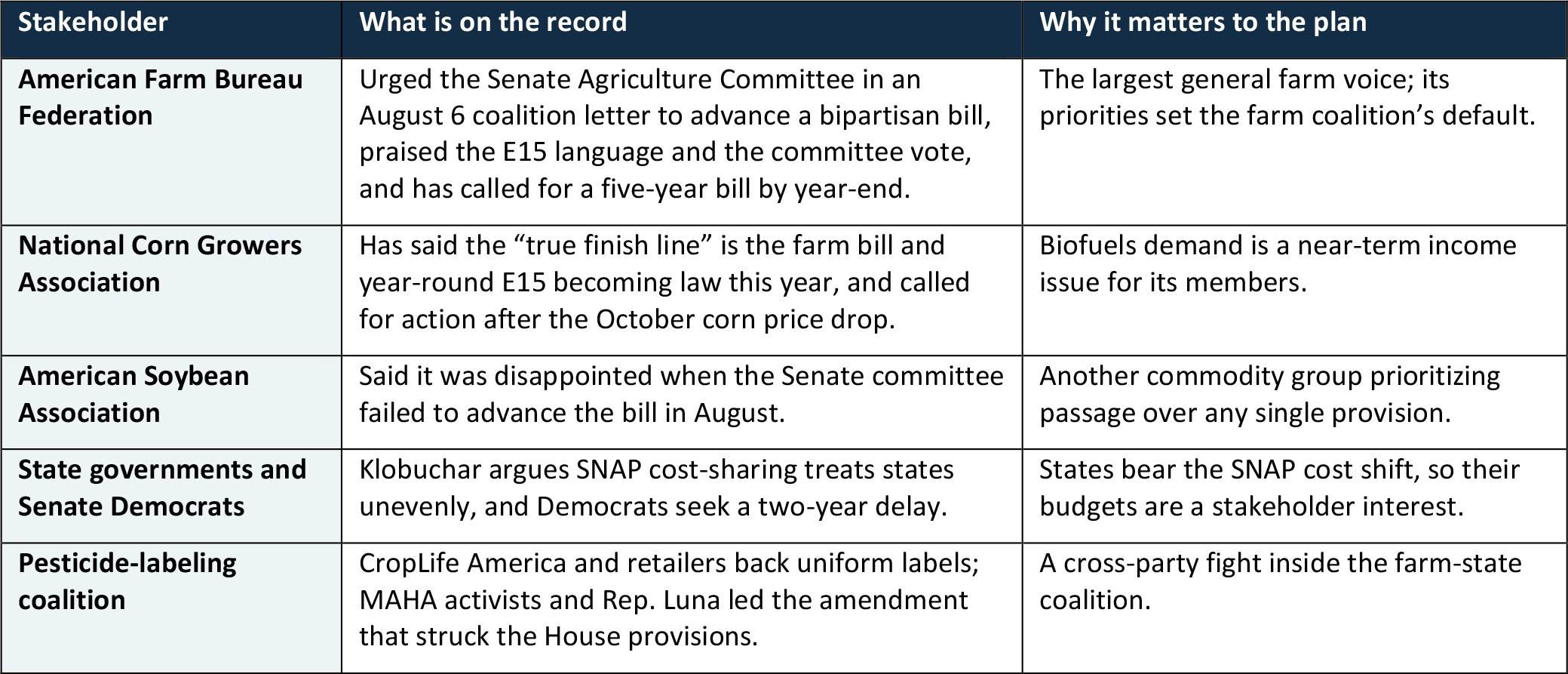
- The farm economy reaches far beyond farms. Rural lenders, equipment makers, input suppliers, and food retailers all feel crop prices and farm-income support. Their positions on the bill often differ from farm groups’ and are rarely mapped.
- Tariffs cut both ways inside agriculture. Exporters welcome pressure on trading partners, while Klobuchar links tariffs to grocery prices. A June 2026 Section 232 proclamation moved agricultural equipment into a reduced 15% duty tier, showing downstream cost pressure reaches the administration.
What this changes in the playbook
- Find partners outside the farm lobby. Lenders, equipment dealers, and rural health and food-retail interests share some of the farm economy’s stakes and may carry messages farm groups cannot.
- Know where the farm coalition splits. SNAP, Prop 12, and pesticide labeling divide groups that agree on E15 and the safety net. Treat each as a separate coalition.
- Use the lame-duck window. NCGA and AFBF are pressing for action in November; the post-election Congress may be the last chance before leadership changes.
Three scenarios, one lens
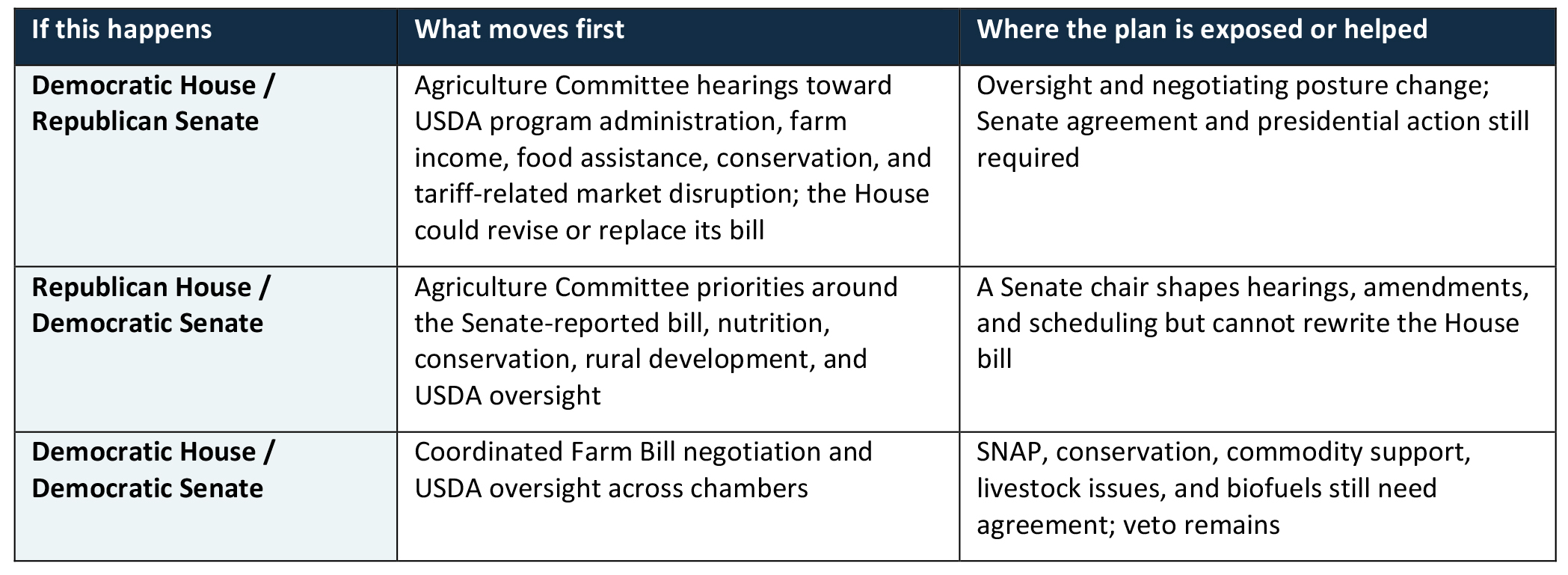
Where government-affairs effort earns its keep
- Compare the two texts line by line. Identify the two or three provisions with the clearest effect on the organization or members, and confirm each program’s authorization status; the September 30 expiration did not affect every program the same way.
- Build a member-level record. SNAP, crop insurance, conservation, livestock rules, and biofuels each have different supporters. Treat agriculture as several coalitions.
- Track the House Agriculture leadership race. After Angie Craig leaves the House, Reps. Shontel Brown and Jim Costa are both reported as seeking the top Democratic slot.
- Map the non-farm stakeholders. Decide which allies beyond the farm lobby could change the negotiation.
People and committees to watch
House Agriculture: open race for the top Democratic slot (Reps. Shontel Brown and Jim Costa reported as contenders); neither is a confirmed 2027 chair candidate. Senate Agriculture, Nutrition, and Forestry: Sen. Amy Klobuchar is the current ranking member and the likely first candidate for chair if Democrats control the Senate and she is selected by the caucus. No 2027 chair is confirmed.
What comes next
After the election, our second piece will go further. It will not be about who chairs which committee, which everyone will cover. It will be about how farm and commodity groups, state governments, lenders and equipment makers, and food and consumer interests are positioning themselves on your issues, and what that means for your strategy, including which options you gain and which you lose when a former ally becomes an opponent or a new partner appears.